Everybody has seen the bright red eyes that sometime show up in flash pictures. Red-eye first reared its ugly head with the Kodak Pocket Instamatic of 1973. Poor design put the flash directly over the lens where the flash could reflect directly off the subject’s retina and back to the film.
Red-eye is now more common than ever as camera manufactures keep putting the flash head too close to the lens. Often the size of the camera gives them little choice. The problem can be solved in several ways.
1. Don’t use on-camera flash. Use natural light or off-camera flash.
2. Make sure there is enough room light that the subject’s pupils are not wide open.
3. Pre-fire the flash so that the subject’s pupils close before the actually picture is taken (this is a very-odd but common solution provided by many camera manufactures.)
4. Retouch out the red later. (This is far easier with digital than with film.)
Professional photographers seldom have problem with red-eye because we seldom use on-camera flash except as a fill. And red-eye was not an issue before 1973 because until then it was not possible to get the flash so close to the lens axis that it would cause a problem.
So that’s the story on red-eye. I hope this will help you tame this ugly dragon.
Tuesday, August 05, 2008
Thursday, July 17, 2008
Panoramics

We have become so accustomed to seeing the world through predetermined shapes that we forget that there are no preset shapes in art. We are used to the format of a television set or a magazine page and assume that our photographs should be 8X10 or 4x6 inches or whatever.
Photographs can be round, oval, or about any shape you like. I have always been drawn to long skinny pictures myself, and began using extreme wide-angle cameras about thirty years ago.
The next time you are trying to see something in a new way, forget about the 3:4 ratio box and think about a long box.
My primary business is people pictures, but I am also one of the few photographers with a lot of experience and affinity for panoramics. My definition of panoramic is a view greater than what the human eye can see, which is about 90 degrees.


Monday, June 30, 2008
Last roll
While sorting through some old files last night I came across some negatives and a contact sheet dated April 2003. I believe that is the last roll of film I shot. I had been alternating between film and digital depending upon the situation, but that was the last roll of 120 Vericolor. Just this morning I dropped 10 rolls of Kodak Professional film and a roll of Fuji in the trash. The film era is officially over as far as I am concerned.
The photographs I am making now are the best I have ever done and I am enjoying it more. The newest digital cameras are amazing. The prices range from $19.95 to over $33,000 which means there is a pretty good variety of cameras out there – just like there has always been.
I’ve heard a few people lament about how much time it takes to correct and print digital images using a computer, but these people obviously never worked in a darkroom. Having owned a custom photo lab for 23 years, I am sure that the vast majority of people had no idea of the work the photo lab put into making their photos look good - or more correctly, how easy it was to make them look bad.
Photoshop has dramatically changed the way I work, but it has not changed the way I see. That is the secret of photography. Ansel Adams said, “The sheer ease of making an image often leads to creative disaster.” That is more true than ever.
Friday, June 27, 2008
Ted Hubbard
A good friend died and went to be with the Lord this week. Ted Hubbard was an attorney and judge in London, England and quite possibly the wisest person I’ve ever known.
I met Ted and his wife, Gladys, through CBMC (Christian Business Men’s Committee.) When I joined the staff of CBMC in 1996, Ted held the title of “Staff Chaplain.” Four times a year Ted and Gladys would come to the United States at their own expense. They would go wherever in the U.S. they were invited and counsel , advice, hang-out, befriend, and whatever seemed appropriate at the time. The first time we got to know the Hubbards was when they road with us back from Colorado Springs to Kansas City. At the time they were in their upper seventies, British proper, and quite content to ride in the back of our GMC Jimmy the 600+ miles across Kansas. We all had a wonderful time.
It was Ted that advised us to take a long view and not make any major changes in the ministry for at least five years. That five years of talking to people, research, and planning eventually led to the opening of Homer’s Coffee House which has been a life-changing adventure for many people.
We were never able to visit Ted and Gladys in England, but saw pictures of their house in Kent and the one near the English shore. We heard about his Austin Princess and their lovely daughters.
I can’t imagine how many lives have been touched and people encouraged by this great man of God.
Thursday, June 19, 2008
Travel

My Dad used to accuse my Mother and me of having the “Go Bug.” That is one of the things that drew my wife and I together. We both have a strong desire to see the world. We decided early in our married life that we would spend our money on travel and not on houses or other expensive hobbies.
The result is that after 37 years of marriage we have been to many interesting places and have closets full of pictures and our minds full of memories to prove it.
The seven years that we spent running Homer’s Coffee House were wonderful but confining. We can’t wait to hit the road to see what is out there to see.
One of the benefits of travel is that we develop a different view of the world. Confined to our own limited culture we begin to think that what is around us is normal. For example, many Americans are unaware that even though the pursuit of happiness is written into our Declaration of Independence, we are only average among the world’s nations in “happiness” surveys. According to a recent article on “60 Minutes” that very pursuit may make us unhappy. Lack of contentment is a very real cause of misery. The “happiest” people in the world are Danes even though their taxes are high by U.S. standards and they pay about $10 per gallon for gas. They drive less, drive smaller cars, and many things that are very expensive here such as health care and college are free in Denmark. But most of all, the Danes are a contented lot. They are very happy with who they are.
Seeing other parts of the world, and getting to know people from different countries is very enlightening. People who go on mission trips, student exchange programs, or otherwise develop friendships across continents, are never the same.
With airlines getting more difficult to deal with and gasoline over the $4 mark, many people are cutting back their travel plans. Don’t do it. Get out there and see America and the world. Higher cost might affect your style. We will probably find cheaper hotels, shop for airfare deals, or rent a smaller car. I expect that higher costs will cause us to have more road side picnics and fewer gourmet meals. But they won’t cause us to stay home.
Tuesday, June 03, 2008
Big Changes
This has been a month of big changes. My last official day at Homer’s Coffee House will be June 13. I have opened a photography studio at 10851 Mastin Suite 130, Overland Park, KS 66210. This is in Corporate Woods – the most prestigious office park in Kansas City.
I have been a photographer since I was in the fourth grade and it is really the only thing I ever made any money at, although I did work my way through college playing music. I came out of college debt free due to my ability to play the bass guitar, so that makes me a certified professional musician and a professional photographer.
As I approach sixty, I decided it was time to open my “dream” studio, and this may be it. I have been photographing my favorite people – musicians – since I first picked up a camera. I have photographed Sonny & Cher and Harry Chapin if that gives you an idea of how long I have been doing this. It is still fun and I intend to establish myself in the coming months in the Corporate Woods as a people photographer for executives, businesses, as well as performers.
I will be posting recent photos on www.MathisPhoto.net, so take a look and give me a call.
Monday, April 21, 2008
Friends
I’ve been thinking a lot lately about friendships. The problem is that there are not enough good words to describe the range of positive relationships. The two most common are “friends” and “acquaintances.”
There are people I have known for many years, that I have a great deal of respect for, that are much for than acquaintances, but if I call them “friends,” what do I call the people that I see often and have many shared experiences and shared interests? Best friends or BFFL (best friend for life) seems sort of trite.
The basic building blocks of relationships are shared experiences and shared interests. Obviously, these vary a lot from relationship to relationship. My closest friends are the people I play music with. Music speaks directly to the heart, so playing music together builds strong relationships through shared experiences, shared passions, and strong emotions. Other musicians are also among my good friends because we have a common language and shared interest. I presume people who play golf together, go hunting together, or ride motorcycles together have similar relationships.
I once asked a fellow musician if she had any good friends that had never heard her play. Her answer was one that that I have not recovered from yet. She said, “I have chosen to give my life to making music, if a friend has never even bothered to come hear me play, they wouldn’t be much of a friend.”
Along those lines, if someone showed open disdain for the things you love, whether it is music, photography, or fishing, it would be hard to maintain much of a friendship. Two of my passions in life are music and photography. For me, photography is an individual pursuit, while music is a team sport. Therefore I don’t have as many photographer friends as musician friends. But if you have spent fifty years trying to make beautiful pictures and someone says to you, “How can you enjoy life with that thing (camera) in front of your face?” It becomes hard to call that person a friend. That doesn’t mean that we don’t occasionally hurt the people we are close to, often just trying to be funny, but we do have to know when to apologize and when to be sincere. The old movie said, “Love is never having to say you are sorry.” Actually, love is saying you are sorry a lot.
In a marriage relationship, we have to plan for shared experiences and shared interests. That is what makes a long term relationship possible. Other relationships are the same way. For friendships to be real, we have to share interests, share passions, and share experiences.
Saturday, February 23, 2008
Watch your heart - and the press.
Presidential candidate John McCain drew some flack this week from The New York Times for a presumed impropriety with a female lobbyist. I don’t know anything about John McCain’s personal life, but I do know that a person has to very careful with how things might look to others.
Thirty years ago my wife and I agreed that we would never be alone with a person of the opposite sex. This has been a good rule if at times a little difficult to maintain. This means that when meeting with friends, clients, or associates there may need to be three people there. If meeting with a female salesperson or associate, I always ask somebody else to come along, or else we meet in a very public place, such as a coffeehouse.
When my wife was on staff with a church, she never had one-on-one meetings except with other women. I have female friends, but I always make sure that either their husbands, my wife, or a third party is present when we talk.
I believe this plan came originally from Billy Graham. Billy and his wife have the same rule and it has served them well for decades.
This rule has served us well as well. Not only does this system prevent any appearance of impropriety, it also goes a long way in keeping our lives pure.
Tuesday, February 12, 2008
Big Ears
My definition of a good musician is one that can play a wide variety of styles and genres. A person who likes a wide range of music we say has “big ears.” As musicians the best thing we can do is listen to all kinds of music.
My heroes are the people who can play in a blues band on Friday, sing a contemporary song at a wedding Saturday afternoon, play in a country band on Saturday night, and lead worship on Sunday morning.
The worst thing we can do is be publicly critical or condescending of a style of music that is not our favorite. I remember when the jazz musician, Stan Kenton, criticized country music. His stature as a musician dropped many points in many people’s eyes. I’ve heard country musicians make fun of hip-hop and vice versa. Please resist this temptation. It only makes you look uninformed or worse.
I was thinking of this while watching a little bit of the Grammy’s the other night. There were 110 Grammy’s given. Only a handful were presented on air, but the Grammy for best polka album or the best traditional folk album is just as important Song of the Year. And I didn’t hear anybody making fun of another genre. We are all in this together.
Friday, February 08, 2008
Empowering
Louise and I were out of town for a few days. When we returned, I noticed a bar stool sitting in the back room. I was told that there were some screws loose. I quickly grabbed a screwdriver, tightened the screws and returned the stool to the counter.
It wasn’t until several minutes later that I realized that there is not one of our fifteen employees who are not capable of turning a screwdriver. When I related this incident to other small business owners, they all agreed that this is a common problem among entrepreneurs. We are so use to quickly solving problems that we have inadvertently trained our people to wait for us to solve their problems, no matter how small.
I realized that by not allowing, in fact insisting, that problems be solved by those present, I have made much more work for myself and stunted the growth of the business. This is probably why most start-ups need a new person to take the business to the next level. The entrepreneur is just not willing or able to hand over responsibility to others.
I would like to think that I have learned my lesson, but the truth is doing things myself is part of my make-up. “Empowering” others does not come easy.
There seem to be two types of people. Corporate types who can easily say, “That’s not MY job.” And entrepreneurs types who think everything is their job. It is hard to find a middle ground.
Monday, January 28, 2008
Music and Food
Wake up in the middle of the night in a truck stop,
Stumble in the restaurant, wonderin’ why I don’t stop.
Steve Earle – Guitar Town
I don’t know about Earle, but I do it for the food. Jennifer Lynn Smith played Homer’s last weekend. After the gig, the inevitable question came up. What’s for breakfast? Even though Jennifer is a Prius driving folkie, I recommended Village Inn – the skillet breakfast with sausage and some Tabasco. It seemed like the perfect ending to a great night of good music. She agreed and off they went for a post gig feast.
Which brings up the question, does different genres require different food. We usually think of blues and barbeque, country and fried chicken, and folk and tofu. During my early rock and roll days, every gig was finished off with two eggs over easy, hash browns with ketchup, and toast. But I don’t know if the definitive study has been made. If anybody has a clear opinion on this let me know.
Sunday, January 06, 2008
Artists and athletes
I have always been a little concerned about calling a musician or a singer an artist as is the norm in the music business. But lately the term is beginning to make more sense. A performer is as much an artist as a painter or sculptor is in that sense that it is a form of creative self-expression and requires both skill and heart.
But singers, musicians, dancers, and actors are more than artists, they are also athletes. As athletes, they must train, practice, and rehearse to train their muscles to react instantly without thought. Also like athletes they may face injuries, health, and just plain getting old. But unlike in athletics, the creative side does not diminish with age. As we get older, we may not be able to play as fast, or hit the highest notes, but we can certainly play with more expression and passion as we have the gift of time behind us.
In the past it seemed like musical history was made by young people, but I am not sure that is the case now or will it be in the future. Creativity does not rely solely on flexible fingers and vocal cords. It takes clear thinking, a passion for life, and time and skill to get the art recorded in a form that others can enjoy it.
Monday, December 17, 2007
Send me a man who reads.
When I was a child by family subscribed to “Reader’s Digest.” I was always the first one to grab it. The second thing I did was go through and read all the jokes. But the very first thing I read, even before all the jokes and cute stories, was an ongoing ad series by The International Paper Company. It was a series of biographies and vignettes about people and what they liked to read. The title and punch line was always “Send me a man who reads.” ( I understand that this series ran in several national magazines in 1960-61.)
The whole point of the series was that reading is the single most affective habit and the greatest skill we can possess. There is no greater predictor of success in life than how much and what a person reads.
I am constantly amazed at the amount of information available on virtually every subject. There are books, magazines, videos, conventions, conferences, trade organizations, and on-line forums on any and every thing a person can think of. The bottom line is this: there is no excuse for ignorance.
For a Christian, primary reading should be the Bible, but after that the possibilities seem endless. The Bible has inspired more writing than any other subject in history. There are commentaries, study guides, insights, and opinions on anything a person would ever need to know.
But reading other subjects is also worthwhile. I would not consider any major endeavor without first reading everything I can find on the subject. Before we opened Homer’s Coffee House, I read six or seven books about coffee for example. I am constantly amazed by people who have very limited knowledge about an activity that they are deeply involved with, when all they need to do visit the library or a bookstore and find tons of literature about the subject.
It’s simple – “just send me a person who reads.”
Wednesday, December 12, 2007
There is a lion in the street!
Ever since I have been involved in retail, I have been trying to figure out the relationship between the weather and the amount of customers. This week I finally figured it out.
The weather has very little effect on business, but the weather forecast has a lot. Monday and Tuesday the television news was filled with gloom and doom – we are all going to die – news of an impending ice storm. Throughout those days we had steady rain, but the temperature remained near or above freezing with little to no ice on the streets. Business was down by 50%. (Other areas did fair worse, but our city dodged the ice.)
Finally the fear mongers got tired, the temperature dropped into the 20’s, and today with icy streets, business is back to normal. Would somebody like to explain this to me?
Proverbs 22:13 says, “The sluggard says, ‘There is a lion outside!’ or, ‘I will be murdered in the streets!’” Ecclesiastes 11:4 says, “Whoever watches the wind will not plant; whoever looks at the clouds will not reap.”
The victory belongs to the ones who are willing to go out and face the world, not huddle in front of their TV’s hearing about how bad things are. This applies not just to the weather, but in every other situation as well.
Tuesday, November 13, 2007
Jumping to Conclusions
The other day, two ladies were setting in the window at Homer’s. I asked if they needed anything else and one committed on the neighborhood being rather shabby. (Keep in mind that we are in one of the top 5 or 6 counties in the nation in per capita income.) I asked why she thought that and she said, because they had been setting there for over an hour and had not seen a single cab go by. I asked where they were from and she said Detroit. I presume there are neighborhoods where the taxi drivers don’t want to go in Detroit.
I decided to not explain that everybody in Overland Park has 2.3 cars and there isn’t much need for taxis. I also didn’t point out that the taxis we do have are unmarked Lincoln Town Cars. I volunteered to call them a cab, and sure enough when the cab arrived it was a silver, unmarked Lincoln.
A few days later a young man asked me what nationality I was. He was amazed when I told him that I was an American and, in fact, had lived in Kansas my whole life. He said he was quite surprised because I had a deep voice and American’s have high pitched voices. As near as I could tell he was an American. I don’t know where he had been.
This week a well-dressed man came in asked us to steam some milk, pull a double shot of espresso, and then pour the steamed milk over the espresso. I wrote “latte” on the ticket. He apparently he didn’t know that he had just described the most basic coffeehouse drink there is. I presume he also walks into McDonalds and asked them grind some beef, fry it on a grill, and put it in a bun, not realizing he had just described a hamburger.
It just keeps getting weirder out there folks.
Saturday, October 27, 2007
Music, food, & drink
Somebody has probably done a study on this, but there seems to be quite a difference in what the fans of different performers eat and drink. At Homer’s Coffee House, for example, some are a bit predictable and some are not.
It is not surprising that when Randy Davenport plays that we would sell a lot of brewed coffee and apple pie because he plays country with patriotic themes. More surprising is that Kenny Gamble fans would eat so much carrot cake.
I don’t know why Bob Jenkins fans drink decaf lattes. I don’t know if it is because Bob is stimulating enough without caffiene, or they just are planning on getting to bed early.
I would be surprised if the high energy guitar sounds of Sky Blue would bring in the soy drinkers. But soy and herb teas seem to fit The Subs just fine.
Mission Blues fans drink a lot of milk shakes. Maybe it is because they heat up the place.
Maybe I will do a more detailed survey. This may be a whole new branch of science.
Saturday, October 20, 2007
Disposable vs reuseable
It is a common misconception that young people are more environmentally conscience than older people. My experience shows the opposite to be true. College age and younger people are about ten times more likely to request disposable plates and cups than older people. But last night was still amazing.
Three young people (college age) came in and ordered pie. As I began to serve them pie on glass plates with stainless silverware, they asked if they could have them to go. I put the three pieces of pie in styrofoam boxes (which I hate to do), put them in a plastic bag and tossed in plastic forks. They paid the bill and immediately went over and sat down at a table, took out the boxes and began eating out of the styrofoam boxes with the plastic forks.
I went over and told them that I would be happy to put the pie on plates or give them "real" forks, but they said no, they were fine.
This is not that unusual. Eating out of plastic boxes is uncool enough, but the intentional waste of resources is inexuseable. With this sort of cavalier attitude toward single-use items, it is no wonder this country consumes far more than our share of natural resources.
Wednesday, October 10, 2007
Keep the main thing the main thing
The new Sprint Center in downtown Kansas City opens this week; the same week that Gary Forsee lost his job as the head of Sprint. In addition to spending millions for naming rights for the new arena, Forsee oversaw the merger with Nextel and was well respected in community affairs circles.
Unfortunately he missed one little issue – Sprint telephones don’t work. I was one of the thousands who left Sprint for another carrier after years of frustration with weak signals, dropped calls, and just plain lousy sound quality. I now enjoy talking on the phone again since I can understand what the other person is saying and I don’t live in constant fear of missing calls or loosing the signal in mid-sentence.
The lesson here, for the rest of us, is simple. Remember to keep the main thing the main thing. Don’t get distracted by side issues while ignoring the basic product or service you are trying to provide.
The same is true in our personal lives. Our relationship with God and others is the main thing. It is easy to get caught up in less important issues.
Monday, October 01, 2007
Praising vs Performing
I play in the Christian blues/rock band, “Sky Blue” in addition to my church’s praise band, so, I think a lot about the differences. The purpose, and therefore the focus, of the two are quite different. The purpose of the praise band is to lead worship, to help people see God more clearly. The focus is on the Lord. The purpose of the blues band is to entertain and the focus is on the audience. This results in some dramatic differences in the approach.
At church we do simple songs that the audience can sing along. We do not want to detract from the worship with either bad playing or virtuoso playing. We want the music to be transparent. The challenge is to keep the music from being a concert.
In Sky Blue the opposite is true. Even though a secondary goal is for people to see God more clearly, the primary focus is on the audience. We want them to know that Christians can have fun and make great music. We want them to go away thinking “What a great band!”
Two bands, two purposes, two approaches to performing – it can be a challenge to keep the two sorted out. Granted, it is easier for me because in Sky Blue I play a lead instrument and sing. In the church band, I play bass and don’t sing, so the two are dissimilar to my brain..
Most of the people reading this are probably in the same situations. What is your experience?
Wednesday, September 12, 2007
Bicycles
The other day some friends stopped by for coffee in the middle of their bicycle ride. They commented that the two miles from their house was quite a ride. Since I have ridden over 100 miles in a day on more than one occasion, I was not too sympathetic. When they left I noticed that they were riding “Cruiser” bikes, the kind with fat tires, wide soft seats, flat handlebars, and not very many gears.
My bicycle is not exactly the newest technology, but it does have narrow tires to reduce rolling resistance, drop handle bars for better weight distribution and better aerodynamics, a narrow seat that is actually more comfortable in the long run, and 12-speeds for hills.
I figured there might be a life lesson here. Sometimes the comfortable way is not the best way. Like pedaling a heavy cushy bike compared to a light responsive bicycle, taking the easy way out may result in a lot less satisfaction in the end. God never intended for us to be comfortable all the time. He expects us to attack life with gusto. That Lazy-Boy chair and big screen TV may be barriers to a contented and satisfying life. We need to stretch ourselves and maybe go for what looks like a little discomfort. It may be that, like that dropped handlebar, skinny-tire bicycle; it is a whole lot more satisfying in the long run.
Thursday, August 30, 2007
90 and going strong
Today I attended a birthday celebration for a friend who turned 90. Bill was a pilot. He began flying DC-3’s for TWA in 1942. He met his wife her first day on the job as a flight attendant. They have been married 58 years.
In 1977, when the FAA said he was too old to fly passengers, he moved to Pakistan and then South America to keep flying. He returned to Kansas where he has been an encourager and an inspiration to thousands of people.
Bill never misses an opportunity to talk about his faith or about the great life God has given him. Because their life is filled with friends and vitality, you would never guess their age. Both Bill and Evelyn seem twenty years younger than the calendar indicates.
I often talk about the need to finish the race strong, and here are two people who are doing it.
Monday, August 06, 2007
Music Fans?
At a music conference I attended a few months, one of the speakers committed that only about 10% of the population is music fans. I was surprised by this statement because I thought everyone (well, almost everyone) loved music. I quickly realized that this percentage depends a lot on your definition of "fan."
His definition of a music fan was simply someone who liked a wide variety of music, could listen to a song all the way through, could identify different instruments and styles of playing, and could recognize virtuoso playing when they heard it. It turns out that there are not as many people in this category as most musicians believe.
The speaker was a radio consultant – the type of person that record companies hire to try to get their records played on the radio. His comment was in response to a question about why radio stations play the same tedious, unimaginative, handful of songs over and over when there are tens of thousands of recordings released every year, most of them quite good. He was explaining that radio stations are not as dumb as they seem because the vast majority of people don’t want to hear anything new and most people have very limited taste when it comes to music – probably because they only listen to a handful of boring unimaginative songs over and over again.
This would explain why it is easier to get ten thousand people to pay $75 to go to an arena, where they can’t see or hear, to see a well known performer than it is to get one hundred people to go to a much more intimate setting, with great sound, to see a solid band for fraction of the cost.
I became aware of this year’s ago when I would invite friends over to listen to music – usually a new artist that I wanted to share. I always came away frustrated because before the first cut was through they would be talking over the music about something else. I quickly learned that not many of my friends were anywhere near as interested in music as I was. For the next twenty years, music became a very personal thing where I would discover new artist, buy their records, become fans, and never tell anybody else. Only recently have I developed friends with similar interests that I can share music ideas with.
I guess the point is: God made us all different. We each have our own interests and passions. I seldom watch a football game all the way through and I would have a great deal of difficulty telling the difference between one play to the next, or one position to another. I couldn’t tell you when deer season starts, but I know the difference between a Telecaster and a Stratocaster. Isn’t it great that God didn’t make us all the same?
Wednesday, August 01, 2007
Be careful who you hang with

Homer’s Coffee House hosts an open mike jam session every Monday night during the summer. This is a time designed to promote community and give new or first-time performers a chance to play. At the same time it gives more established performers an opportunity to play songs that they might not normally do.
We just go around the circle and give everybody a chance to play and sing. The variety of people who show up each Monday is amazing. It is not unusual to have a person who has never sung in public before do a number followed by professional rock and roller singing a country or folk song. We never know what is going to happen.
I have noticed an interesting phenomenon. Some nights everybody sounds great, and other nights, it seems, everybody is struggling just to stay in tune. The reason, I believe, is that we are greatly influenced by those around us. If there are two or three people in a row who are having a hard time carrying a tune, the next person up, even if they are an experienced musician, is likely to struggle to stay on pitch. Conversely, a few good musicians elevate the whole group to do better.
I think this principle applies to other areas of life as well. If we surround ourselves with quality people, we are likely to perform better ourselves. The opposite is also true. If those around us are goof-offs and low-achievers, our own expectations are soon going to be diminished. This does not mean that we should totally avoid people we think are somehow “inferior,” but it does mean that we need to choose our friends wisely. It means that we need to be in a positive work environment if we want to accomplish great things.
Years ago, I played music with a guy whose favorite saying was, “Dumb is contagious.” Turns out that he was restating what the book of Proverbs says when it cautions us to not be companions of fools, but rather associate ourselves with people who will help us learn and grow.
Saturday, July 21, 2007
Craftsman Part II
A friend was in last week lamenting about the quality of workmanship from the people who had come to repair her apartment. I concurred about how hard it was to find people who knew how to do stuff. I wrote about that in this blog back on September 8. Then I pointed out that our educational system is upside down with the best students discouraged from learning a craft. This leaves us with the lowest performing people doing the most important work, like repairing cars and putting on roofs.
This is contrary to scripture where the Bible tells us to work with our hands and honor those who do. When God came to Earth as a man, He chose to do so as a craftsman – Jesus, the woodworker.
I was reminded this week that a big part of the problem is the way craftsman are portrayed in the media. I happened to be watching “America’s Funniest Home Videos.” The set-up was that this four year old was showing great promise as an appliance repairman. I thought they were going to show a four year old who had dismantled his mother’s washing machine or a kid with the vacuum cleaner in pieces on the floor. Instead they showed a little boy bent over with part of his behind showing. I wonder how many hundreds of young people decided not to be appliance repairing repairmen with that one clip. I know if I was a sixteen year old with plans to go to technical school, I would have reconsidered after seeing just that one ten-second clip.
What the video really showed was that TV producers consider themselves better than appliance repairmen. This is a premise I would seriously doubt.
Thursday, July 05, 2007
Servanthood

My mother and I just returned from an Alaskan cruise aboard the Royal Caribbean ship, “The Visions of the Sea.” It was a fun trip, but the thing that impressed me most was the crew.
There were 755 crew members from 51 different countries on board. Needless to say they came in all shapes and colors from many different backgrounds. The one thing they had in common was a servant’s heart. Along with that came a strong work ethic and a desire to please, not only the passengers, but each other.
We made an effort to get to know some of the crew and find out a little about them. Some were taking time off from college or right out of school, others were seasoned professionals, while I’m sure others just needed the money. But they honestly respected each other and worked hard to make the cruise a wonderful experience for everyone involved.
One of the crew members commented that the crew was like the United Nations except that here they actually liked each other. My observation is that at the U.N. the purpose is to defend your countries honor at all cost; on board ship, the purpose is to work together and get the job done. This makes a huge difference. I half jokingly suggested that we should fire the United Nations and give the job over to the crew of a cruise ship, after all most of the nations are well represented. I honestly believe that a solution could be found to most of the world’s problems within a few days.
Jesus talked a lot about being a servant. He emphasized the importance of having a servant’s heart and looking out for the other guy. As usual, we have the wrong people in places of authority. Usually, only those looking out for themselves make it to be leaders of their countries. Ambassadors are then giving the job of honoring their country and its leaders. Few have any desire or motivation to actually solve problems and help those in need.
Unfortunately, I didn’t encounter any ship crew members who wanted to go to the U.N., they would rather serve each other and their guests.
Wednesday, June 13, 2007
Simplicity
Several years ago I was doing both still photography and video work. I decided to drop the video because it wasn’t that much fun. I later realized why. Still photography takes a slice of life and distills it down to a clean glimpse. It seeks it tell the story in a small rectangular slice of time. Video, on the other hand, adds chaos to an already busy world.
That is why I don’t watch television. When I get home, I have had enough sound, movement, and color for the day. I don’t need manufactured stimulus to distract me.
Simplicity is a concept that seems to get short changed a lot. I see many places where complication and layers of complexity are added with little reason. For example, since I have a background in sound systems, I pay attention to things like microphones and speakers. In many places, wireless mikes have replaced wired microphones, adding complexity and unreliability with little other benefit. Every sound guy knows that wired mikes sound better, have less noise issues, and cost a lot less than wireless. Why then do they spend hundreds of dollars on microphones, receivers, and batteries for a mike that spends its life on a stand?
Cars are another example. Hybrids are big news, but they are exceedingly complicated. In the long term, that means unreliable and expensive to repair. Diesel cars are simply by comparison, get similar mileage, and last several times longer. Yet diesels have been slow to catch on in the U.S., possibly because they are simple and don’t have the high-tech image of the hybrids.
The old adage K.I.S.S., Keep It Simple Stupid, has gone out of favor. We have added layers of complexity to even the simplest pleasures such as shopping for music and talking on the telephone. I believe our lives would be a lot better if we looked for simple solutions not the most complicated solutions. The Bible says to aspire to a simply life. I am not ready to join the Amish, but I think they make some good points. A simpler life is a better life.
Thursday, June 07, 2007
Yes, there is a story.
The other day couple of men were at the counter at Homer’s Coffee House. One of them picked up a copy of my book, “Saving the World, One Latte at a Time, The Story of Homer’s Coffee House.” He read the subtitle out loud and then declared, “You mean this place has a story?”
I didn’t say anything, but it sure struck me as odd. After all, every place and everybody has a story. In retrospect, that may have been the dumbest comment I’ve heard in months. Not everybody writes their story, but they certainly could. Certainly, everybody business has a long and interesting story. The hours, days, and years, of planning and sweat that make up even the most modest enterprise could easily fill a book.
Our lives are a story that we play out day by day. Our lives open like a book before us we play out our lives each step of the way.
Does this place have a story? Stories are written here everyday. People meet, get married, and start lives together before our eyes. Business deals are made and lives are changed over a cup of coffee.
I feel sorry for those poor saps who don’t see the stories, don’t know the stories, or are even surprised there is a story.
Friday, May 25, 2007
Life is Good
I saw a car with both a “Life is Good” decal and “Darwin” emblem. I agree that life is good. I believe we need to protect life, cherish life, and live life in all its forms to the fullest extinct. But the “Life is Good” idea and the Darwin emblem are a big contradiction.
Life is good because a creator god created us and every living thing. He gave us each a place, a time, and a purpose. It is pleasing to God, and to ourselves as well, when we seek that purpose.
Darwinist believe that we are here as a result of some great accident of time and space. Therefore our only purpose is what we create for ourselves. It certainly takes a lot of brain work and self-searching to find a good life in that.
One of the characteristics of this post-modern generation is that they are comfortable with contradictions. They can readily accept opposite beliefs at the same time. Others of us have a hard time believing that there are such things as: jumbo shrimp, liquid gas, original copies, constructive criticism, military intelligence, and a just war.
Sunday, May 13, 2007
Thin and Rich
“You can be both rich and thin if you have self-control.” I think of that when I walk by the cookie case at Homer’s. The cookies seem to call louder than my desire to stay fit. Sometimes the cookies win, sometimes I win, but it is always a struggle. My favorite drink is still a milk shake. That wasn’t too bad back when I was six feet tall and 150 pounds. I am still six foot, but it has been a while since I saw 150, so I must limit the number of milk shakes I drink.
As for finances, the basic principle is spend less than you make. If we do that over time we will accumulate wealth. If we spend more than we make, we accumulate debt.
One of the fruits of the spirit from Galatians 5 is self-control. Self-control in our spending and self-control in our eating have clear long-term affects. The opposite of self-control is gluttony. Gluttony is a sin that has as much to do with over-consumption as it does with over-eating. We can over-consume in all kinds of areas from our houses and cars to the clothes we wear. Over-consumption is rampant in American society. Self-control is out-of-style.
I want to be thin and fit, have money in my pocket, and be a person known for self-control. They all go together.
Tuesday, May 01, 2007
Beauty
A few weeks ago The Washington Post ran an article about an experiment they ran. They asked world famous classical violinist, Joshua Bell, to play in the subway. He played a 45-minute concert of some of the world’s most beautiful music on a $3.5 million Stradivarius violin.
Only one person recognized him, and one other stopped to acknowledge that this was a superb music performance. The vast majority didn’t notice.
This does not surprise me at all. Every Friday and Saturday, during our concert times, people come into Homer’s Coffee House where I work, order their drinks and leave – having never even glanced at the stage.
Just about every week, somebody will comment to me about a magic moment on stage, a debut performance of a great song or a career best solo by a jazz artist, that had gone mostly unnoticed by the audience.
I don’t know what this means. It may indicate a lack of arts education in the schools, but it probably just means that we are too busy or too wrapped-up in our own affairs to pay attention to what is going on around us.
I describe myself as a musician, a photographer, and writer. What that really means is that I am an observer of life. I try to look for things of beauty around me. I might try to capture them with a camera, write about them, or show it to the world somehow through music. As a photographer it seems that my job is to look for beauty in God’s creation, and then force people to look at it by putting it in a box and hanging it on the wall.
I hope that if I heard great music in a subway station I would stop to listen – I have in the past. But I have probably missed a lot to.
God gave us beauty for our enjoyment. I believe we please Him when we take the time to do so.
Monday, April 23, 2007
Contentment
I had the privilege Sunday to make my debut with my church praise band playing bass. I play pedal steel guitar with Sky Blue, and before that, Dobro with Electric Prairie, but it had been a while since I had my trusty bass out of the house.
I began playing bass in 1964 and bought my current bass new in 1970. It is a Gibson Les Paul and every time I play it I am reminded of how much I love that instrument. Every few years for the past 37, I have gone to a music store to look at new basses, and I have never seen one that matches the tone, beauty, or craftsmanship of my old Gibson.
Needless to say, I am very content with the bass. I began thinking of other things I have that I have no intention of ever replacing – either because I consider them perfect, or I like them just the way they are.
Number One – my wife, she’s perfect.
My car – a Volkswagen Passat. If it ever wears out, I will buy another just like it.
My Emmons pedal steel guitar.
The National Tri-cone pictured on my profile.
My cat – Bonnie (she’s purrr-fect too.)
Wrangler jeans.
The leather chair that we bought 35 years ago.
The JBL speakers sitting in my living room.
There are a lot more, but you get the idea.
The Bible says to be content with what you have. Don’t go striving after newer, bigger, flashier. Sure, we can make improvement in our lives, but being content with what we have is the basis for true joy and happiness.
Tuesday, April 17, 2007
My Rolex
In 1976 I bought a used watch from a friend. It was a Rolex Daytona Cosmograph. I paid him $150 for it. I wore it everyday for the next half dozen years. During that time I spent about $600 to $700 keeping it running. This included sending it to Switzerland once for a clean and lube. It was becoming apparent that wearing an expensive watch everyday was not practical – a little like commuting in a Ferrari.
One day I was at a trade show in Chicago when a man offered me $1200 cash for the watch off my arm. I sold it to him on the spot and went to Dillards the next day and bought a Swatch for $50. I couldn’t have been happier. I loved the Rolex, but it was becoming a burden.
Paul Newman was photographed several times wearing a watch exactly like mine, and that model has since become known as the “Paul Newman Watch.”
Not long after that I began seeing ads wanting to buy Rolex Daytonas for $3,000 and up. The current book value is $17,000 with a recent auction high of $84,000.
Do I regret selling mine for $1200? Not at all. Sure, I would rather have $17,000 than $1,200, but, to me, a $17,000 watch would be a real burden. I could never wear it, and keeping it safe and in good working order would be a chore.
Hebrews 12:1 says, “Let us lay aside every weight…and run with endurance the race that is set before us.” Expensive watches, cars, or guitars are not bad things, but they can certainly weigh us down. I know people with cameras so expensive that they never take them out of the house, musical instruments so expensive that they never get played, and cars so expensive that they never get driven. I guess just knowing that you have them can bring pleasure, but to me they are burdens that keep us from life.
The watch that I wear now, I bought at a kiosk at Oak Park Mall. It is not a Rolex, but it works just fine and when it quits, I will throw it away and buy another one.
Wednesday, April 11, 2007
The Ability to Communicate
A friend of mine, who happens to be a college professor, told me the other day that his definition, or the minimum requirement, of a Bachelors Degree is the ability to communicate. A person with four years of college should be able to communicate, both verbally and in writing, in a clear concise way. I had not really thought about it before, but that seems to make sense. If that is all we learn in the pursuit of a B.A. or B.S. degree, it has been worth it.
At Homer’s Coffee House, we can tell in less than ten seconds if an applicant is someone we want to hire. It is all in their communication skills. If a person speaks clearly, looks you in the eye, and speaks in complete sentences, they are in an elite group. Chances are if that is the case, they can write clearly as well.
The ability to speak and write clearly is a primary indicator of future success in life.
Jesus was a master communicator. He was able to attract thousands to hear his stories and teachings. He didn’t have a college degree, but clearly he understood the importance of being able to make his thoughts and ideas clear.
Speaking and writing doesn’t come naturally to most of us, but instead requires work, training, and practice. Understanding the importance of communication is a good first step in making your dreams and vision a reality.
Monday, April 02, 2007
Christian Independent Artists Conference

From March 30 through April 1, Sunny Sundberg, Rob Robinson, (from Spirit's Wind) and I were in Nashville, Tennessee for the CIA Summit. (That is Christian Independent Artist, not Central Intelligence Agency.) The Summit is sponsored by Indieheaven, an organization for independent Christian musicians and performers.
The conference was a hit on three levels: entertaining, informational, and spiritually challenging. A common theme seemed to be calling or mission. Several times we heard the statement: “Do it for the mission and the provision will come.” Understand your vision or your purpose. Margaret Becker said, “If you don’t have a vision, someone will gladly provide you with one, and it will benefit them, not you.” If you know “the why” the “what” and “how” will follow.
The conference was a hit on three levels: entertaining, informational, and spiritually challenging. A common theme seemed to be calling or mission. Several times we heard the statement: “Do it for the mission and the provision will come.” Understand your vision or your purpose. Margaret Becker said, “If you don’t have a vision, someone will gladly provide you with one, and it will benefit them, not you.” If you know “the why” the “what” and “how” will follow.
To see photos and read the whole report, click here.
Tuesday, March 27, 2007
Why I Believe
I believe that Jesus is God, that he came to earth in the form of a man and taught a lifestyle based on love, joy, peace, patience, kindness, goodness, faithfulness, gentleness, and self-control. I also believe that He is coming back some day, and that whether I am alive or dead, I will meet Him in the sky and live with Him forever in a place called heaven.
But I could be wrong. Jesus could be just a myth or at best a good teacher. If that is the case, I will have lived a life of love, joy, peace, patience, kindness, goodness, faithfulness, gentleness, and self-control, and when I die, I am dead – end of story.
But if I chose to not believe and I were right; my life would probably be characterized by greed, self-indulgence, and trying to find happiness the best way I could.
On the other hand if I chose not to believe in Jesus and I were wrong and Jesus really was God and everything He said was true; I would live life my own way and then on that judgment day sometime in the future, face an eternity in a terrible place usually called hell.
To me the choice is plain. I would rather believe Jesus and be wrong that not believe Him and be right.
Tuesday, March 20, 2007
Friends and Fans
This morning I had breakfast with a group of men I see on a regular basis. As I walked in one of them said, “Hey, you look like Johnny Cash,” referring to my black pants and black jacket that I wear about 75% of the time. I laughed and commented that I like black. Another guy said, “If you could only sing like Johnny Cash, too.” I said, “Actually I hear that a lot,” thinking of the half a dozen people a week that say I sound like Cash. As the banter continued, I realized that none of the men in the room had ever heard me sing or even knew that I played in a band, even though I am sure I brought it up on several occasions.
Nobody there knew that I had sung “Big River” and “Folsom Prison Blues” to a packed house and cheers just three days before. I couldn’t think of a way to mention it without sounding like I was making something up or bragging, so I just let the subject drop.
The point is – most of us are multi-faceted and many areas of our lives don’t cross each other. I often ask musicians how many of their friends have heard them play. Surprisingly, the answer is often – not many. They often lament that their fans and friends are two different groups of people, making it very hard to talk about their music and musical accomplishments with their friends.
I don’t know the application to this story other than the fact that we often don’t know our friends very well. Our relationships are often superficial. It is very difficult for more than a small handful of people to know us well enough to know what we care about or what we think. It is difficult for us to know our friends and what they care about. But it is worth the effort. Everybody is worth knowing and worth finding out what makes them tick and what makes them come alive.
Friday, March 16, 2007
Forgiveness
The news is full of sectarian and ethnic violence. In Africa, the Mid-East, and elsewhere, feuds and conflict that have been going on for generations, erupt at the slightest provocation. Despite many social injustices, this country has been relatively free of such conflicts. The reason is that we have a strong culture of forgiveness.
One of the solid Christian principles that has deep roots in American society is the concept of forgiveness. Sometimes it is not easy, but we know that we must forgive others, just has God can forgive us.
Like most Americans, I have an eclectic mix of ancestors. Some members of my distant family had their land stolen from them by order of the U.S. Supreme Court when gold was discovered on their land. The U.S. Army arrested them and forced them to walk from their ancestral homes in Tennessee, North Carolina, Alabama, and Georgia to Oklahoma. Thousands died along the way. They were Cherokee and the forced march is now called the “Trail of Tears.” The Cherokee were not savages but rather successful merchants, craftsman, and farmers. This was only about four generations ago, yet the Cherokee have forgiven the United States and are loyal US citizens.
Another part of my distant family came here in colonial days fleeing religious persecution in Europe. It is seldom mentioned that they were Evangelicals fleeing persecution by the Roman Catholic Church and the Catholic controlled governments. That is what was on their minds when the establishment clause was written into the constitution. Evangelical Protestants and Catholics are both forgiving people and this is now considered ancient history.
More recently, my family members came here in search of jobs and land. They left impoverished situations in search of a better life, just as many still do today. Like today, they weren’t necessarily met with open arms. They had to work hard to prove themselves worthy to be called Americans.
Other people were kidnapped from their villages in Africa, put on ships heading to America and sold into slavery. Even though they were freed less than 150 years ago, forgiveness is the order of the day.
Without forgiveness, this country, too, would be embroiled in ethnic and sectarian violence. Just about everybody would have no trouble thinking of a “beef” against their neighbor.
The answer to world peace is easy – forgiveness. People must forgive each other for past atrocities, and keep on forgiving because we are going to keep on treating each other badly.
Saturday, March 10, 2007
Square Watermelons

My old High School buddy, Wayne Norton, now Dr. Wayne Norton of the First Baptist Church in Coffeyville, Kansas, reminded me of the square watermelons grown in Japan. It turns out that all you have to do is put the watermelons in a square box while they are growing and they will grow to the shape of the box. Pretty cool, huh?
Of course the same thing happens to people. Put us in a square box while we are growing and we take on the shape of the box. Any shaped box for that matter will shape us just as well. Most of us didn’t have the opportunity to decide the type of “box” we grew up in, but since we continue to grow our whole lives, we can change boxes whenever we want.
The box may be our relationships, it may be our neighborhood, or it may be the entire culture shaped by the media, music, and entertainment that we expose ourselves to.
As adults, we have lots of control over what we put in our minds. We have dozens of TV channels, millions of songs on iTunes, thousands of books, and hundreds of magazine and newspaper titles to choose from. If we choose to degrade our lives and conform to the lowest common denominator of the culture we certainly have that option.
Romans 12:2 says, “Do not conform any longer to the pattern of this world, but be transformed by the renewing of your mind. Then you will be able to test and approve what God’s will is – his good and perfect will.”
Friday, March 02, 2007
Kansas City Star Opinion Page
I was pleasantly surprised this morning to see an essay I wrote on the Opinion page of the Kansas City Star. It is pretty much taken from this page a few months ago, so it may sound familiar to my regular readers.
In case you missed it, here is the link:
http://www.kansascity.com/mld/kansascity/news/opinion/16813778.htm
In case you missed it, here is the link:
http://www.kansascity.com/mld/kansascity/news/opinion/16813778.htm
Tuesday, February 20, 2007
Fishers of Men
Luke 5 tells the story of Jesus calling some of his disciples from a group of fisherman. He said, “Follow me, and I will make you fishers of men.” Like many people, my image was one of an angler standing beside a trout stream or a lake, slowing casting a line. Down the shore was another fisherman doing the same thing. Occasionally they would exchange pleasantries –“Catching anything?” “No, you?”
But that is not the context here. Jesus is talking to a fishing crew who had just pulled in boatload of fish. When Jesus implied that His followers would be “Fishers of Men,” he was obviously thinking about a crew working together, repairing nets, driving the boat, hauling in the nets, and sorting fish. That is a much different picture than the loan fisherman casting a line with a rod and reel. Unlike a stringer of bass, a boatload of fish is not particularly pretty. There are all sorts of things in the net. A Biblically functioning church will have all sorts of people. Drug addicts, alcoholics, and ex-cons will be sitting next to doctors, lawyers, and teachers.
Not surprisingly, that happens everyday at coffeehouses such as Homer’s, sporting events, and often, the workplace - less often in church and Sunday School.
If we are on a fishing-boat crew, no one person can point to a fish and say that one’s mine. We are all in it together. We’re working together to build one another up, building a better community, and growing “The Kingdom of God.”
Friday, February 02, 2007
Ski Time

Well, it looks like I am not going to make it skiing this year. This is one of the few years out of the past 25 when we have not gone on a ski trip. It is not that I am such a great skier or that I even love it that much. After all, a person isn’t going to get very good at anything doing it just 2 or 3 days a year. I just love everything about skiing.
I love riding in the car across Kansas with my wife. I love the first sighting of the mountains. I love riding the lifts and having lunch on the patio of the Summit House in 20 degree weather. Then later, walking down Main Street in Breckenridge and having dinner at the Whales Tail. Oh sure, the skiing is fun too.
But the overall affect of winter sports, whether it is skiing, snowboarding, ice skating, or snowmobiling, is that it completely changes one’s attitude about winter. When I am loading the car in the parking lot at Sam’s in single-digit weather, it reminds me of unloading boots and skis in the parking lot at Copper Mountain. Walking across the yard in knee-deep snow reminds me of cross-country skiing in Yellowstone. Driving on snow-packed roads is part of the experience, and when this too is associated with something fun, it makes the whole thing more bearable.
Knowing that we have skied all morning in sub-zero weather at Jackson Hole makes going to work at plus-six no big deal. I know for a fact that my car will start at minus thirty five, so I don’t worry about it at zero. I think this is the concept that James was talking about in James 1 when he said, “Consider it pure joy, my brothers, whenever you face trials of many kinds.” He goes on to say that the trials make us mature and lead to wisdom. That is how we get stronger.
Now if I can just think of something to like about the heat this summer.
Monday, January 29, 2007
Looking out for others
One of my ongoing pursuits is trying to figure out why some people are successful at whatever they want to accomplish while others are always floundering.
One clue is found in the Bible in Philippians chapter 2, verse 4. Paul say’s “Each of you should look not only to your own interest, but also to the interest of others.” The Message paraphrases it this way, “Put yourself aside, and help others get ahead. Don't be obsessed with getting your own advantage. Forget yourselves long enough to lend a helping hand.”
This is not only scripture, but the best business advice I can think of. Zig Ziglar say’s, “You can get everything in life that you want, if you help enough other people get what they want.”
We have had a few issues lately with people either leaving early or arriving late to work. We try to accommodate people’s needs, but the real problem is that if one person has to leave early, arrive late, or call in sick, somebody else’s plans are changed. One person being late for work means somebody else has to work later than they had planned. One person’s desire to put their own plans ahead of their work commitment means somebody else has to cancel a date, change dinner plans, or miss an important meeting.
The ability to put other’s interest ahead of your own, in the long haul, translates to one thing – winners and losers. Selfishness always looses. Looking out for others always wins.
We are very fortunate in our business at Homer’s Coffee House to be able to help young people learn these principles early. It is a joy to be able to help shape the work habits of young people, greatly increasing the chances that they will be labeled with the winners, because they have learned the importance of service, hard work, and looking out for the interest of others.
Tuesday, January 16, 2007
The Culture of Sameness
On a recent trip to Europe, the first thing we noticed, in big cities and small towns, was that 95% of retail businesses and restaurants were single location, usually with the proprietor behind the counter. There are very few chains, big box stores, or franchises. This is in a remarkable contrast to the US where small owner-operated shops or cafés have all but disappeared. As a result we have less choice, lower quality, and certainly no personal service.
I have been trying to figure this out for several months and the conversations I have had with other small business owners are alarming. Contrary to popular belief, most can compete with the “big guys” on a level playing field quite nicely, thank you. The problem is that the field is not as level as you might expect.
Developers and landlords seem to be increasingly unwilling to rent to anyone but national accounts, (click here) to the point of canceling leases for owner-operators and seeking to fill the space with national chains. There is a growing culture that thinks that small is bad, familiarity is good, and that unique is undesirable. That is why a drive down Dodge in Omaha, or Metcalf in Overland Park or any other shopping street in any American city looks exactly the same.
A while back we were visiting relatives in a city 2,000 miles away. When the subject of lunch came up, they suggested Red Lobster, Olive Garden, or Applebee’s, the same restaurants that are within six blocks of our home. These places are all OK, but they could be anywhere. Signs of local flavor are quickly disappearing.
I don’t have a solution. I have only begun to identify the problem. I have seen window decals in Chicago saying, “Support your Local Merchants,” encouraging neighbors to support their neighbors. This might be a start, but local merchants don’t need benevolence, they just need to be able to rent prime space at market rates, have access to goods at fair prices, and be treated the same as other businesses when it comes to taxes and regulations.
It is hard to compete when the big chain down the street is getting tax breaks, strong arms the supplies to get rock bottom prices, and intentionally drives out competition. But owner-operators have the advantage of knowing the customers, knowing the community, not having to rely on reports to know how business is doing, and having consistent management.
I would like your ideas about this situation. Click on the “comments” link below.
Wednesday, January 10, 2007
Meeting people's needs
Churches and ministry organizations are often accused of being out of touch with the needs of the culture, and rightly so. We can go along for years being totally ineffective and be content in our own little world. But big commercial organizations can make huge mistakes as well.
Take cell phones as an example. Motorola demonstrated a handheld portable cell telephone in 1973. The press made a big deal out of it stating that the completely portable wireless telephone would change the way people lived and that the world would never be the same.
Unfortunately nobody at Motorola, AT&T, or the FCC believed it. Little effort was put into developing it and little bandwidth was assigned. AT&T was so convinced that there was no commercial potential that it gave away the technology it had developed. This was in spite of the fact that pop culture had forecast, and the public longed, for such a device for years. Dick Tracy had his wrist two-way radio in the 30’s and Adam Smart had a telephone in his shoe in a 1960’s TV show. If there was ever a demand for a new technology, this was it.
A consultant for AT&T predicted that the world-wide market for cell phones would be about 900,000. They missed it by a factor of 1,000s. There are now billions of cell phones in use. For that reason we now suffer from overcrowded frequencies due to not enough bandwidth, highly compressed signals, and a confusion of standards, resulting in poor sound, weak signals, and dropped calls. All because demand is far greater than the major players ever expected.
Even a casual observer of culture can see that there is little need for wired telephones or broadcast television, yet billions of dollars have been wasted on these technologies. People stay home to watch TV, but they need a telephone wherever they are, not the other way around. Looking at a picture of the radio spectrum it is easy to see that huge chunks are given to broadcast television while only a few slivers are designated for personal communication.
I am sure there was a reason for this at the time. Television just followed the model of radio even though radio is a portable device and portable TVs have never caught on. Who knows why portable phones were so long in coming? I tried to get a car phone in the 1960’s only to find that there was a long waiting list due to the fact that there were only a few frequencies available. Doctors and emergency personnel were given priority, so the chances of a photographer getting one were slim.
The point of all this is this: we need to be aware of people’s needs and wants and work to supply those needs. Just providing what we want to provide or what is easy is not the model demonstrated by Jesus. He met people’s needs whatever they were.
Tuesday, January 02, 2007
Stuff, stuff, stuff
Four year’s ago, Louise and I sold or gave away two-thirds of our possessions and moved from a four-bedroom house to a two-bedroom apartment. It was not at all an easy thing to do. In fact it was one of the hardest things we have ever done. But in retrospect, it was well worth the trouble. We had no idea how weighed down we had become with extra stuff in our life. Since then we have kind of become the “go to” people for those wishing to down size and simplify their lives.
The first thing I tell people is to figure out who you are and get rid of everything that isn’t you. For example, I now describe myself as a musician, photographer, and writer. That means that I am not a woodworker, a mechanic, or gardener. Therefore I do not need woodworking equipment, mechanics tools, or gardening tools. By my own definition of who I am, I only need musical instruments I can play, a camera that works, and a computer to write on. Everything else is superfluous and could be discarded.
Of course it isn’t that simply, but you get the idea and that is a good start. Eliminating equipment for hobbies I no longer pursued helped clean out my basement. It also helped in reducing the size of my library.
In the kitchen we had our good dishes and our everyday dishes, our good silver and our everyday stuff. The simple decision that we were good enough for the “good stuff” all the time allowed us to get rid of all the everyday day stuff and use the best stuff everyday. Our lifestyle went up and the clutter went down.
In my case at least, the accumulation of stuff was caused by the pursuit of different interests over time. I restored an old car and ended up with mechanics tools and car parts. Since I don’t even work on my own car anymore, I don’t either. Multiply that principle by twenty and you get the idea.
Clarity of purpose and a clear understanding of who we are and what we want to do will go a long way in simplifying our lives. Staying focused on our calling and sharpening our passions will help eliminate the junk in the basement and garage.
God created us with a purpose. Satan’s plan is to keep us distracted with stuff to the point that we never get around to completing God's purpose.
Friday, December 29, 2006
Finishing Strong
As we wrap up another year, it is a good time to think about starting and ending strong. In the performing arts, whether it is drama or music, the opening and closing are most important. The first line of a play or the first stanza of a concert sets the tone for the whole show. Then the very last line or ending of the last song stays with the audience and determines to a large degree their overall feeling about the performance.
In our band rehearsals, we spend a good amount of time on the intros and endings. How do we start the song and how do we end it? We want to end a song (and the show) clean and strong.
This is a good metaphor for life. The first few years of life are extremely important and will serve to set the tone for the rest of our life. But the ending is also important. A surprising number of people do not end well. This week James Brown died. Brown’s importance to popular music cannot be overstated. His titles, “The Godfather of Soul” and “The Hardest Working Man in Show Business” were well earned. I saw James Brown back in 1967 and his performance set new standards as to what was possible on stage. He influenced generations of musicians both black and white. But even a short biography of him must mention his felony convictions and other bouts with the law, mainly in the latter part of his life. James Brown was not a hood who made good, he was a person who grew up in church, became a super-star, and went bad.
He is not the only one. George Eastman, the founder of Eastman Kodak, the one man that did more to bring photography to everybody than anybody, died at his own hand. A surprising number of successful business people die bitter. Finishing strong is certainly not automatic and, in fact, requires quite a bit of conscience effort and planning.
It is complicated by the fact that life gets harder at a time when we think it should be getting easier. That makes us angry. We can either give up and become bitter, striking out at anyone who will listen, or we can decide to stay in the game. Play the game until the last out is made or play the song until the last chord is struck. It really is our choice.
Tuesday, December 19, 2006
God's love at Christmas
Christmas time is my favorite time of year. Sure I get tired of the commercialism, but love is always just below the surface. People are hurrying around trying to get last minute shopping done, but many if not most, still take time to think about others.
One my wife and my Christmas traditions is to go out to eat at a nice restaurant, just the two of us. We usually do this a few days before Christmas. Since Christmas is usually spent with families, we want a special time for the two of us. We have done this every year for the past 35 years.
As is often the case, this year we went to the Plaza. The Country Club Plaza is our favorite part of Kansas City and our home for a few years until last year. We decided to go to Houston’s for ribs. It seems odd that the best ribs in a barbeque town are not even at a barbeque restaurant, but Houston’s are the best.
As we finished up our dinner, the waitress said, “Oh, by the way, your ticket has been taken care of, you don’t owe anything.” It seems an anonymous person had already paid for our meal. What a joy and blessing to know that someone was willing to share love in such an unselfish way.
Even during a time in my life when resources were much more plentiful than they are now, I never did that.
We have many opportunities to share the love of God with others. Paying somebody else’s ticket at a restaurant is one; but lending a hand to person in need, or an ear to someone who just needs to talk, also shows Gods love.
But why wait until Christmas, I want to show love to those around me every day of the year.
Monday, December 11, 2006
It's Almost Christmas!
I was at a pancake house in Chicago last week when I overheard the guy next to me complaining about Christmas. He said it was just an old pagan holiday and had nothing to do with Jesus and he wanted no part of it. After I listened to him rant for a few minutes I decided to join the conversation. (One should always listen for a few minutes before joining a conversation already in progress.)
I agreed that December 25 was originally the day that the Romans celebrated the birth of the sun. But when Constantine became a Christian in the fourth century, he changed it to the day we celebrate the birth of Jesus – the son. Constantine wanted to honor Jesus’ birth and also give credibility to Christians by giving them a holiday. Since the actual date of Jesus’ birth was unknown, he took an existing holiday, by then associated with a pagan custom, and converted it to Christmas. You can do that sort of thing when you are the Emperor. We have been celebrating December 25, Christmas, as the birth of Jesus for nearly 1,700 years.
Christmas is one of my favorite holidays because it reminds me of Jesus’ humanity. Even though He was God, He chose to be born as a baby, raised in a working class family, and preach love, forgiveness, and a simply lifestyle. Like the man in Chicago, I too am a little put off by people spending huge amounts of money to celebrate the birth of a man that they don’t know or hardly care about.
In modern day America where a person’s value is determined by how much “stuff” he has, it is only reasonable that we would honor our friends and relatives by giving them more “stuff.” In Luke 12:15 Jesus said, “A man's life does not consist in the abundance of his possessions.” This is a hard fact to get into our heads in a culture where the opposite seems to be the conventional wisdom.
Remember that Jesus Christ is Lord on this special day when we celebrate His birth.
Monday, November 27, 2006
Voice Lesson Day
Mondays are special days because that is the day I have my voice lesson. You see, since I was a very small child, I always wanted to sing. Because I wasn’t very good, I was discouraged from singing by my teachers, parents, relatives…well, I guess about anybody who heard me sing.
After I became a Christian and the subject of spiritual gifts came up, I always wished that I had been gifted as a singer. I even silently prayed that God would give me my desire to be able to sing.
Finally, after fifty years of quietly wishing I had the ability to sing, I decided to start singing. I am not sure why I started, other than just fifty years of desire finally broke through.
At first, I was pretty tentative, but eventually I gained confidence. My wife suggested that I take singing lessons. I decided to take that as encouragement rather than discouragement. This summer I began taking voice lessons from Ronni Ward. I now singing regularly with my band and at church.
I have been getting a lot of compliments, most of which start with the phrase, “I didn’t know you could sing.”
Here are the questions: Did God answer my prayer and suddenly give me a singing voice? Did I always have the ability and just needed to develop it? Or is singing a learned skill that just about anybody can learn with enough desire and a good teacher?
The fact that music is never mentioned in the Bible in the context of giftedness, leads me to believe that singing or playing an instrument, are skills, a craft if you will, that just about anybody can learn, given enough time, motivation, and teaching. If there is giftedness involved, the gift is the desire to spend the time and energy required to develop the skill.
Let me know what you think.
Ronni Ward's response...
Thank you Jim. I think your'e onto something there about developing and learning. I would have to disagree about giftedness. There are some people who have a certain amount of ability and can work at it and increase their skill. These people may not be especially "gifted" in that particular area; whatever it may be, but there is value and purpose in it. For instance, take my guitar playing ability. I have to work extremely hard just to accompany myself to an acceptable level. Then there are guitarists like David George, Brian Ruskin, David Smart or Bonnie Raitte (not your cat). While it's true that becoming that good is a lot of disipline and hard work, I would say they are "gifted" in that area. Bob Dylan is known more for his songs than for his voice. His voice is important, but his songwriting is his gifting and he will never be what Elvis or Reba are (or were) to the world... vocally speaking. Musical giftings are never more important than the gift of being an encourager or a leader or a manager etc., only more coveted and perhaps more noticed.
I just wanted to get in my two cents. I would have responded with a blog message if I knew how to set up an account. I guess blogging's not my "gifting" I may have to work at it.
Feel free to share this with whomever you wish.
Ronni
Thursday, November 23, 2006
Changing Times
I was just watching John Fogerty performing during the half time of the Chiefs/Broncos game. A few minutes in a stadium hardly gives a hint of this man’s talents, but it was fun to be reminded of the great Creedence Clearwater Revival music.
While watching Fogerty, I was also looking through some old photo magazines. Reading reviews of products that have long since come and gone, I couldn’t help but think about change. Only ten years ago, I was considered a master at a craft that is now obsolete. For over twenty years, I was as good as anybody in the world at making black and white photographs. Film, chemicals, and photographic paper were my livelihood and life. It has now been years since I was in a darkroom, and I am not sure why anybody would want to be. Digital cameras, computers, and ink jet printers can easily surpass film in quality.
The world has changed. Creedence Clearwater Revival is history and Tri-X, Plus-X and D-76 are heading for museums. Resisting change is not only futile but dangerous. John Fogerty does some nostalgic shows, but he is also doing new music, always looking ahead. Somebody has wisely said that those who resist change will inevitable be affected negatively by that resistance.
In business, we risk being left behind. In college economics we talked about buggy whip manufactures. Today we could be talking about film processors, video tape editors, carburetor mechanics, or mainframe computer programmers. Businesses have to constantly be looking down the road to stay ahead of fast moving technologies.
In ministry, it is not so obvious. Because the bottom line is not easily measured, we can be years behind without even knowing it. Peter Drucker said that if you are doing anything the same way you did it 5 years, it is probably wrong. I know of many ministries, churches, and other not-for-profits that are still following the same model set up by the founders in the 1930’s, 40’s, or 50’s.
As Christians, we cannot afford to ignore the changing cultures. We must be relevant, flexible, and proactive if we want to bring Christ’s message of love and reconciliation to a hurting world.
Wednesday, November 15, 2006
Squandering Resources
It seems that those of us who consider ourselves evangelical Christians have come to the environmental debate a little late. In the book of Genesis we are a given the task of managing the resources of the planet. It is probably because we don’t want to be associated with those who would worship the creation and ignore the creator, but that is not a very good excuse. In many areas we have squandered resources and largely made a mess of things. Jesus was particularly critical of those people who wasted resources and opportunities.
I don’t believe that we can be better stewards by just trying harder and recycling newspapers and aluminum cans. There is a need for total culture change. A recently heard about a couple who built what may be the “greenest” house in the nation. It uses all sorts of technical gee-whiz such as active solar and ground affects. It was not mentioned that the house is 30 miles out in the country and that they work downtown. Between the two of them they likely commute 100 miles a day or more. Clearly, this was an academic exercise with no intention of saving fossil fuel.
In the past twenty years the average new home has more than doubled in size. The average fuel economy of all the cars on the road has not changed, in spite of the fact that there has been much technical advancement. Obviously gasoline prices, natural gas, or electric prices have not had an effect on our lifestyles or how we choose to spend our money.
A large coffeehouse chain makes a big deal out of their recycling efforts but offers only single-use cups and utensils. Using glass cups and stainless steel utensils would save millions of tons of paper and disposable plastic and reduce waste dramatically. Most goods we buy are over-packaged, wasting much paper and plastic and filling our land-fills.
Our culture tells us that it is good to build a “McMansion” in the suburbs and commute 30 miles in a large vehicle that barely makes twenty-miles to the gallon. At the same time, those who share a few walls with their neighbors, reducing utilities cost by 80 – 90 %, and walk or bicycle to work, are considered weird or somehow under-privileged.
In a free society, most choices come down to economics. As long as we have relatively cheap fuel, people will continue to buy huge houses and drive inefficient vehicles too far to work.
In countries with no domestic petroleum resources, where gasoline regularly runs $5.00 per gallon or more, most people walk, or ride bicycles or scooters to work; apartments or townhouses clustered together to save energy and build community are the norm; and automobiles get 40-50 miles per gallon.
I believe that we will make great strides in improving the environment and saving resources, not from complicated technologies like hybrid cars, but from simply deciding that spending an hour a day in the car driving to our 5,000 square foot house is not the way we want to spend our time and money.
Thursday, November 09, 2006
Bonnie & Me
My cat and I adore each other. I carry her around on my shoulder. She has me all figured out. She knows if she scratches her post she gets a treat. If she rolls over on her back, I rub her tummy. But she has no idea what I am writing about. She certainly doesn’t know what I do all day. Even though she tries, her singing and playing guitar leave a lot to be desired. My relationship with God is a lot like that. His realty is so much beyond mine that I can only understand a small amount and attempt to show my affection for Him through worship and obedience.
When I was about 10 years old, a Sunday School teacher sat me down and went through God’s “Plan of Salvation.” I don’t remember the exact details, but it was something like: 1. God has a plan for my life; 2. All have sinned; 3. The wages of sin is death, but the free gift of God is eternal life; 4. If you believe in your heart and confess with your lips that Jesus is Lord, you will be saved.
This seemed pretty straight-forward and I had no trouble understanding that all had sinned. The problem was that if it was that clear, why wasn’t this in the first four verses of Genesis, or the last four verses of Revelations. Why didn’t Jesus spell this out in the Sermon and the Mount, or at least, Luke should have highlighted it with bullet points. Why do we have to look through pages of scripture and pull out selected verses to find truths that should be so clear. Furthermore, a person could say just about anything using this technique.
Fifty years later, I am very familiar with tracts such as “The Four Spiritual Laws” and “Steps to Peace With God.” These booklets easily explain eternal truths in 10 pages including illustrations, but they open up tons of questions. Questions like, how about the person who has never heard about Jesus? Or what about all the wonderful people in churches who suffer from nothing worse than bad theology?
The problem is that this simplification is like saying that a sandwich is a piece of dead animal between two slices of bread. It is true, but there is more to know. Anyone who has ever talked to a baker about bread or a barbeque expert about sauces and meats knows that a sandwich is never just a sandwich. As I enjoy my PB&J or a veggie-burger, I realize that even my definition of a sandwich is not exactly right.
It is tempting to put God in a box and say we have Him figured out. But God is much bigger than we think or can know. His ways are beyond our widest understanding. Fortunately, we don’t have to understand God’s whole plan. It is not our place to judge or condemn others, but God’s. Our job is to respond to what we DO know - live our lives in such a way that we bring glory to Him.
Wednesday, November 01, 2006
Legalism
I’ve been doing some traveling lately and have therefore been subject to airport security. Of course, everybody is for better security, but the scene at most airport security check points could be something right out of Seinfeld.
Responding to the latest threat, we are now limited to liquids in bottles of less than 3 ounces enclosed in a quart size zip-lock bag. All you have is a fold over sandwich bag? Too bad, your shampoo will be confiscated. A half-full 4-once tube of toothpaste – not good enough. The rules are weird and virtually every checker interprets them differently. One time a sealed bottle of water is OK, the next time it is gone. An empty bottle? It depends on who is doing the checking. What started as a response to a real threat has turned into real silliness.
This is the type of situation Jesus faced. What started as following God’s laws had, by first century Palestine, turned into to a fiasco led by a political party called the Pharisees. A basic idea like honoring the Sabbath had turned into detailed rules about how much a person could lift or how far they could walk. Jesus preached against this idea of following rules to the “T” without thinking, or understanding the intent. Much of His ministry involved attacking the silly rules that were being inflicted on the people. Instead, He brought a message of grace and forgiveness. He gave us the Holy Spirit to guide us in making choices based on knowing right from wrong, not a long list of complicated rules.
Today we call following a set of rules, to the exclusion of thinking, legalism. For example, if many lives have been ruined by gambling, it could be a sin to own a deck of cards. If dancing seems too sensuous, let’s ban dancing. In the book of Galatians, chapter 5, Paul spoke passionately against this kind of thinking. “It is for freedom that Christ has set you free. Stand firm then, and do not let yourselves be burdened again by a yoke of slavery.”
As individuals, we can’t do much about confusing and conflicting airport security, building codes, or other bureaucratic red tape. But we can be careful how we live; embracing the freedom we have in Christ as citizens of the Kingdom of God, and the freedoms we do have as citizens of the USA.
Monday, October 23, 2006
The French Paradox

A lot has been made of the French paradox concerning food. It seems that the French smoke too much, drink too much, and eat fatty foods, but they are measurably healthier than Americans. Few people are over-weight and obesity is non-existent. A quick tour of France answers this question. The French eat less and exercise more. Walking is the most common form of transportation and many people ride bicycles. Restaurants generally serve smaller portions.
The bigger puzzle to me concerns the huge number of small businesses. There are literally millions of small shops and cafes all over France with very few chains, big box retailers, and almost no franchises. The typical street in any French town or city is lined with dozens of small shops with the owner behind the counter. The variety is huge, the service good, and the prices are fair.
I guess my question is: How did we get to the point in this country (USA) where the big boys run the show?
Chains and franchises have homogenized the country to the point that it is very hard to go into a town and not find exactly the same restaurants and stores as the previous town. I recently looked at a copy of “Entrepreneur” magazine and was amazed to find that half the ads were for companies selling franchises. When did we get to the place where having your own business meant buying someone else’s ideas and plans.
America has a reputation for individualist and independent thinking, but that is not at all what you see when you look down any street.
By the way, stop by Homer’s Coffee House. It is the only one;and no, we are not planning on franchising.
Let me know what you think. Click on “comments” below. Maybe together we can figure out this dilemma.
Monday, October 16, 2006
Changes in Latitude - Changes in Attitude
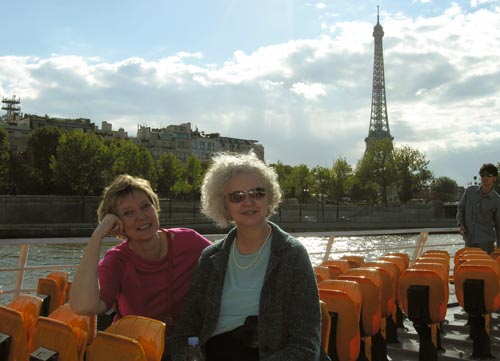
Louise and I and some friends just returned from 10 days in France where we were all celebrating out 35th wedding anniversaries.
It had been a quite a few years since we had been to France, so I had inadvertently bought in to some of the stereotypes and clichés about the French. Was I ever wrong! Everyone we encountered was warm and friendly. We enjoyed lots of wonderful conversations with all sorts of people. Everywhere we looked, people were working hard. The streets were immaculately clean and everything worked. There were no pot holes, no steel plates over the streets. We saw a new bridge that is the longest and the highest in the world. As far as I could tell, all the workers were Frenchmen with very little imported labor.
I suppose that if we hard began speaking loudly in English, demanding that our coffee be watered down and our Coke poured over ice, we might have been treated differently. I am also sure that if a French speaker walked into an American café, speaking loudly in French, demanding that things be served according to his custom, he would not be treated with much respect either.
Respecting other people’s customs and history is an important part of getting along as people. In I Corinthians 9, Paul talks about the importance of respecting the culture in order to share the love of Christ and His message of reconciliation.
We don’t have to travel around the globe to find other cultures, sometime we just need to travel down the street. But the message is still the same. People are people and if shown respect, they will respond with respect.
Sunday, October 01, 2006
I to Me

Over the past few years I have noticed that the personal pronoun "I" is becoming less and less useful to me. Instead the words "we" and "us" appear a lot more in my daily usage. Since we (not I) opened Homer's Coffee House five years ago this weekend, I have learned to rely more and more on my employees, friends, and family.
The things that are most worthwhile in life cannot be done by just one person. We must surround ourselves with a community of people who care about us and care about the things we care about. It is a significant spiritual step to begin thinking in terms of a community and not just about ourselves. It is a big move from "me" to "we."
The Homer's team have demonstrated that to me. It weren't for them, I would certainly have moved on to something else; but the community bond is so strong that I have no reason or desire to leave.
I play in a band - Sky Blue. It has been said that playing music together is one of the strongest of relationships because for several hours at a time we are sharing our feelings and emotions through the language of music in front of a large group of people. It is certainly a clear picture of community where we each have our role and are working closely together for a common goal.
As Rick Warren says, "First of all, it is not about me."
Subscribe to:
Posts (Atom)